
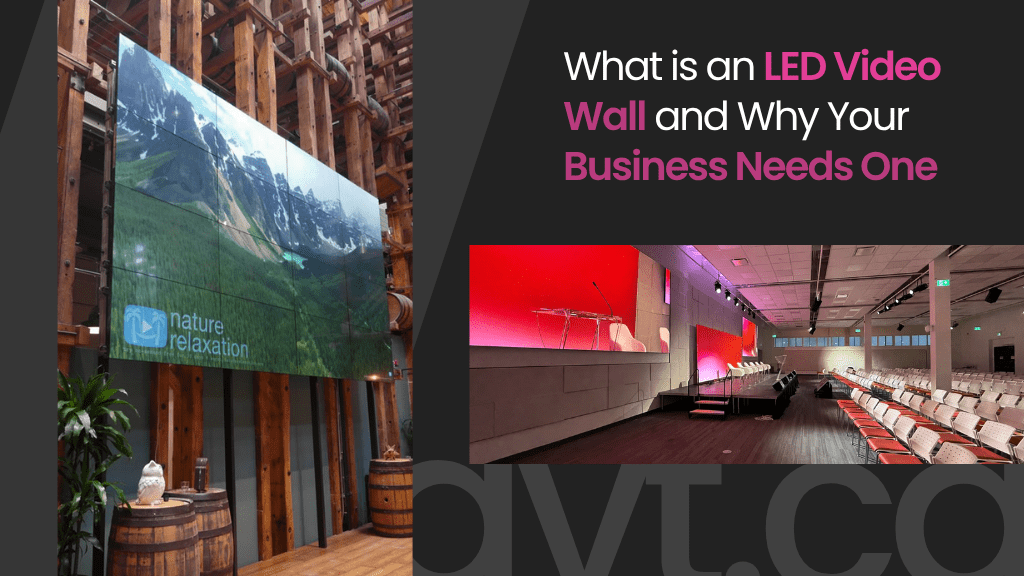
If you have been thinking about upgrading your visual communication, whether for a permanent installation, a corporate event, or a retail space, you have likely come across the term LED video wall. This guide covers everything you need to know: how the technology works, where it makes sense to use it, what the setup process actually involves, and what Canadian businesses specifically need to consider before moving forward.
What is an LED video wall?
An LED video wall is a large-format display system built by connecting multiple individual LED panels together to create one continuous, seamless screen. Each panel is made up of thousands of tiny red, green, and blue LEDs that work together to produce a full-colour image. Because the panels are modular and clip together without visible gaps, the final display appears as a single unified surface, regardless of how large it is.
Unlike a standard television or computer monitor, a video wall LED system is designed to scale. You can configure it as a small 6-foot display in a boardroom or a 30-foot-wide backdrop on a concert stage. The technology does not impose a fixed size limit, which makes it fundamentally different from any off-the-shelf screen solution.
One of the most important technical specifications to understand is pixel pitch, the measurement in millimetres between each individual LED cluster on a panel. A smaller pixel pitch (such as 1.5mm or 2mm) means the LEDs are packed more tightly together, producing a sharper image that holds up at close viewing distances. A larger pixel pitch (4mm, 6mm, or 10mm) is suited for applications where viewers are standing farther away, such as large event stages or outdoor signage. Choosing the right pixel pitch for your specific environment is one of the first decisions in any LED wall project.
How LED video walls are different from projection and LCD displays
Businesses often ask how LED video walls compare to traditional projection setups or tiled LCD screens. The differences are significant and worth understanding before making any decision.
Projection systems require a controlled lighting environment to work well. The moment ambient light increases, whether from windows, ceiling fixtures, or stage lighting, projected image quality drops. LED walls produce their own light at brightness levels that projection simply cannot match, typically ranging from 800 to over 5,000 nits depending on the panel. This makes them effective in fully lit rooms, outdoors in daylight, and in any environment where projection would struggle.
LCD video walls use individual monitors arranged in a grid, but each monitor has a physical bezel, a border around the screen, that creates visible lines across the image. High-end LCD walls have reduced this gap significantly, but it never disappears entirely. LED panels have no bezel. The seam between panels is invisible in normal viewing conditions, giving you a truly continuous image.
LED walls also require less ongoing maintenance than projection. Projector bulbs need regular replacement, which adds cost and downtime. LED panels have a rated lifespan of 100,000 hours or more under normal operating conditions, and individual LEDs can be replaced without taking the entire wall offline.
LED video walls for events: why the industry has shifted
The events industry moved toward LED video walls for events over the past decade, and the reasons are practical rather than just aesthetic. Event producers deal with venues they do not control, lighting conditions that change throughout the day, and content that needs to look perfect regardless of what is happening around the screen.
LED walls solve the ambient light problem completely. A corporate keynote, a product launch, a gala dinner, a trade show booth, none of these environments are set up like a darkened cinema, and projection systems require that kind of light control to look professional. LED walls do not.
For event rental specifically, modular LED panels are designed to be assembled and disassembled quickly. A crew can put up a substantial wall in a matter of hours, and the panels pack down into road cases for transport. This has made LED walls a practical option not just for large-scale productions but for mid-market events that previously relied on projection because it was cheaper to rig.
Content flexibility is another factor. A single LED wall installation can serve as a live video relay, a branded backdrop, a real-time data display, and a full-motion graphic environment, sometimes all in the same event. The content management systems that drive LED walls support live video inputs, scheduled playlists, real-time data feeds, and manual control from a single operator station.
Small LED video walls: What smaller businesses should know
The assumption that LED video walls are only for large venues or big production budgets is outdated. Small LED video walls, compact configurations ranging from about 4 feet wide up to 12 feet, have become genuinely accessible for mid-sized businesses, and the applications are broader than most people initially expect.
A fine-pitch panel arrangement behind a reception desk communicates brand professionalism the moment a visitor walks through the door. A product-focused display in a showroom or retail window runs live content that printed graphics cannot replicate. A boardroom feature wall replaces the chaos of a projector screen, a whiteboard, and a TV mounted in the corner with a single clean surface that does all three jobs better.
The key consideration for smaller installations is pixel pitch. Because viewers in a boardroom or retail space are often standing between three and ten feet from the screen, fine-pitch panels are essential. A panel configuration that looks excellent on an event stage at 30 feet will look pixelated at close range. Getting the pitch right for the viewing distance is not optional, it is the difference between an installation that impresses and one that disappoints.
Small LED video walls also work well in training facilities, university lecture halls, government operations centres, hospitality venues, and houses of worship. Any environment where information needs to be displayed clearly to a group of people at varying distances benefits from this technology.
LED video wall Canada, what Canadian buyers need to consider
Canadian businesses have specific factors to account for that do not always come up in general LED wall content written for international audiences.
Climate is one of them. For outdoor or semi-outdoor LED video wall installations, in building lobbies with glass facades, covered outdoor patios, or exposed signage positions, panel operating temperature ratings matter. Canada’s temperature range from coast to coast is extreme, and a panel rated for -10°C will behave differently in a Saskatoon February than in a Vancouver spring. Panels intended for genuinely cold environments need cold-weather ratings and appropriate enclosures. Any Canadian AV integrator worth working with will factor this into their specification without needing to be reminded.
Building codes and electrical requirements also vary by province. A fixed LED wall installation involves structural mounting, electrical load calculations, and, in many cases, a permit process that is specific to the municipality. The weight of a fully assembled LED wall with steel rigging can reach several hundred pounds, and the building structure needs to be assessed before anything goes on the wall.
Supply chain timelines are a real planning factor. Most LED panels are manufactured in Asia, and Canadian import timelines, including customs clearance, freight, and last-mile delivery, add time to any project that is not planned far enough in advance. Working with a Canadian supplier that carries local inventory or has established import relationships significantly reduces the risk of delays on a time-sensitive installation or event.
How to set up an LED video wall, the full process explained
Understanding how to set up an LED video wall helps businesses ask the right questions and set realistic expectations before a project starts. Here is what the process looks like from beginning to end.
1. Define the application and viewing environment
The first step is understanding exactly what the wall needs to do and where it will be installed. Indoor or outdoor? Fixed or temporary? What is the typical viewing distance? Will content be managed live, through a scheduled playlist, or triggered manually? These answers drive every specification decision downstream, pixel pitch, brightness rating, panel count, mounting type, and software platform.
2. Technical design and layout planning
Once specifications are confirmed, the technical layout is drawn up. This includes the panel arrangement, seam planning, cable routing, power distribution across the panels, and controller hardware placement. A professional AV integrator will produce a detailed render of the final installation so the client knows exactly what to expect before any hardware is ordered.
3. Site preparation
The mounting surface must be structurally assessed and, in most cases, reinforced for the load. Electrical capacity needs to be confirmed, LED walls draw significant power, and older buildings may require panel upgrades. Conduit routing, data cabling, and cable management are all planned and installed before panels arrive on site. This phase commonly takes longer than expected on first-time installations.
4. Panel installation and calibration
Panels are mounted in sections, connected to the controller system, and then put through a calibration process that aligns brightness and colour uniformity across every module. Calibration is what makes the difference between a professional installation and a visible patchwork of mismatched panels. Without it, colour temperature and brightness will vary between panels, which defeats the purpose of a seamless display.
5. Content integration, testing, and handover
Content is loaded into the management system, tested across real playback scenarios, and refined based on how it actually renders on the physical wall. The installation team then trains the client’s staff on day-to-day content management, so the business is not dependent on the integrator for routine updates. A full punch-list review closes out the project before sign-off.
For a standard indoor fixed installation, this full process runs approximately three to six weeks from signed contract to a live, operational wall. More complex installations, outdoor, large-format, or multi-zone configurations, take longer. A reliable integrator will provide a detailed project timeline at the proposal stage and flag any site-specific factors that could affect it.
Common industries using LED video walls in Canada
LED video walls are being adopted across a wide range of sectors in Canada. Retail businesses use them in-store to run product content, promotions, and brand storytelling that drives conversion and dwell time. Corporate offices use them in lobbies, boardrooms, and experience centres to communicate brand credibility to clients and employees. Event venues and hotel ballrooms use them as permanent backdrops that replace temporary production equipment at every event. Sports facilities, universities, transit hubs, and government operations centres all have active installations.
The businesses that get the most consistent value from LED wall investments are the ones that treat content as an ongoing discipline rather than a one-time setup. A wall running stale content does far less work than one with a maintained content strategy. This is worth factoring into the total cost of ownership before committing to an installation.
What to look for in an LED video wall supplier
Not all AV suppliers approach LED wall projects the same way. The questions worth asking before signing a contract include: Do they carry local inventory or is everything imported to order? Do they have a dedicated installation and calibration team, or do they outsource that work? Can they show completed installations in environments similar to yours? Do they provide ongoing support after the installation is live?
For Canadian buyers specifically, a supplier with direct Canadian experience, who understands local building code requirements, climate considerations, and import logistics, will save significant time and money compared to sourcing internationally and managing the project independently.